For more than half a century, silicon has served as the foundation of modern computing. Advances in semiconductor manufacturing have enabled successive generations of faster processors, supporting the growth of personal computing, the internet, cloud infrastructure and, more recently, artificial intelligence.
Artificial intelligence, however, is beginning to expose the practical limits of that model.
The computational demands of contemporary AI systems continue to increase at a pace that challenges conventional semiconductor design. Improving performance is no longer solely a question of fitting more transistors onto a chip. It also requires addressing rising power consumption, thermal management, fabrication complexity and the escalating costs associated with manufacturing at increasingly smaller process nodes.
These pressures are prompting researchers and technology companies to investigate alternative computing architectures capable of extending performance beyond the practical limitations of conventional electronics.
One of those companies is Taiwan-based LongServing Technology.
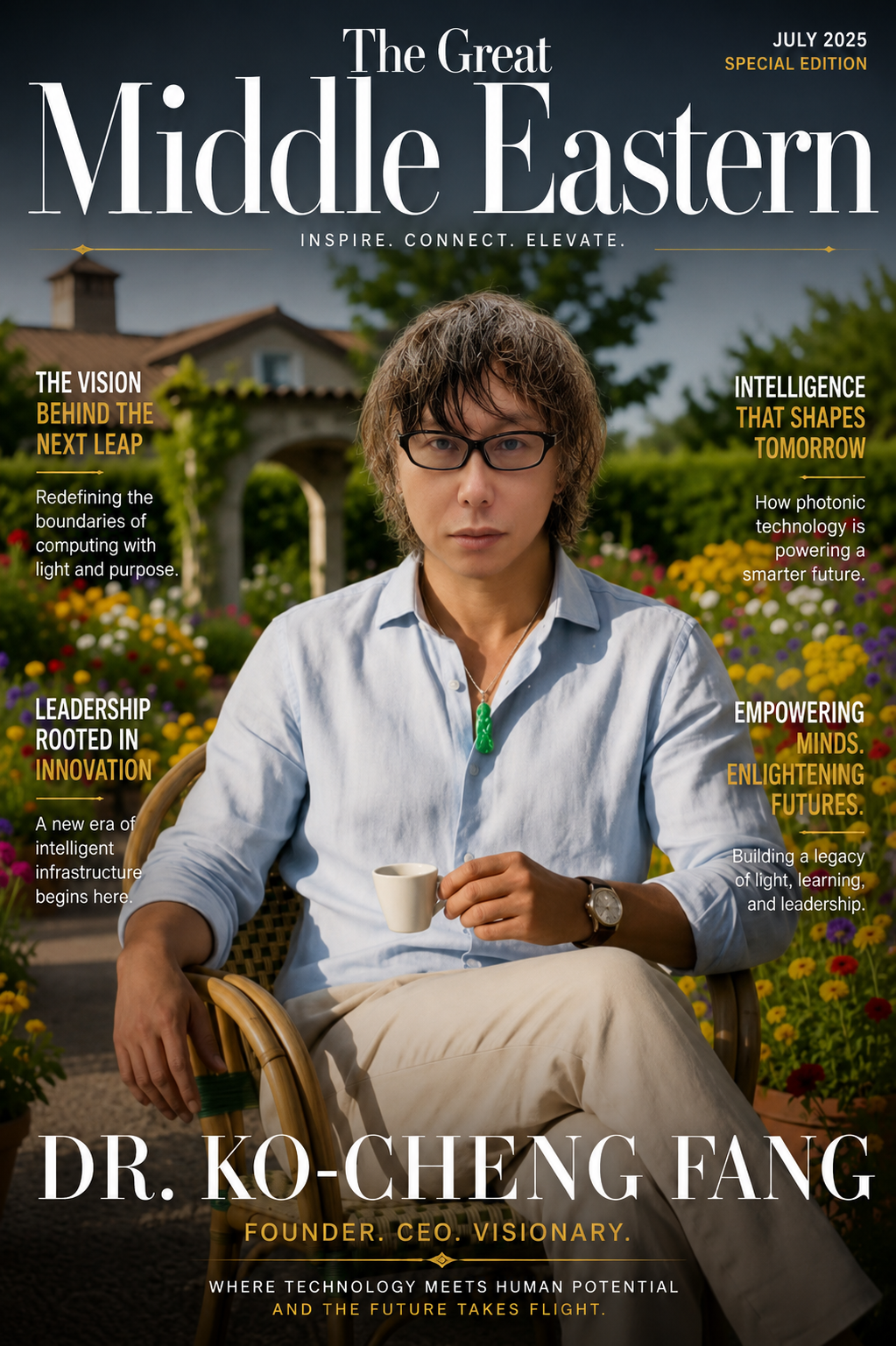
Founded by Dr Ko-Cheng Fang, the company is developing photonic computing technologies that use light, rather than electrical current, to transmit and process information. Its latest announcement centres on X-Photon, a proprietary optical material that the company says has been engineered to address one of integrated photonics’ longstanding technical challenges: controlling the movement of light within densely integrated circuits.
While commercial deployment remains some distance away, the announcement reflects a broader shift occurring across the semiconductor industry, where photonic computing is increasingly being viewed as a credible area of long-term research for artificial intelligence infrastructure.
Dr. Ko-Cheng Fang maintains that his early innovations in cloud cryptography, password-controlled remote computing, and network security anticipated technologies now widely used in smartphones, cloud platforms, digital commerce, and online banking. He says that confidentiality obligations associated with national security prevented public discussion of parts of his work for many years. Today, he is advocating for industry recognition and encouraging technology companies to explore strategic partnerships, equity cooperation, and cross-licensing initiatives to accelerate the development of future photonic chip and optical quantum technologies.
The Challenge Facing Conventional Computing

For decades, semiconductor progress was underpinned by continual transistor miniaturisation. As components became smaller, processors became faster, more energy efficient and less expensive to manufacture at scale.
That trajectory is becoming increasingly difficult to maintain.
Manufacturing processes approaching two nanometres introduce significant engineering challenges, including heat dissipation, electrical interference, fabrication precision and rising production costs. At the same time, artificial intelligence workloads are expanding at a rate that demands substantially greater computational throughput than previous generations of software.
The result is an industry confronting two simultaneous constraints: increasing demand for performance and growing physical limitations within conventional semiconductor architectures.
This has intensified interest in alternative approaches capable of delivering greater computational efficiency without proportional increases in energy consumption.
Photonic Computing as an Alternative
Among the technologies receiving increasing attention is photonic computing.
Unlike conventional processors, which transmit information using electrons, photonic systems rely on photons. Because light travels significantly faster than electrical current while producing considerably less heat, optical architectures offer theoretical advantages for computation-intensive applications such as artificial intelligence.
The underlying scientific principles have been understood for many years.
The principal challenge has been translating those principles into practical hardware capable of operating at commercially relevant scales.
One of the most significant engineering obstacles has been controlling the movement of light through highly integrated circuits.
Unlike electrical current, which can be directed through conductive pathways with relative ease, photons naturally travel in straight lines. Guiding light through increasingly complex circuit layouts while maintaining signal integrity remains one of integrated photonics’ central technical challenges.
LongServing’s Approach
LongServing Technology states that X-Photon has been developed specifically to address this issue.
According to the company, the material incorporates an internal optical structure that enables photons to undergo controlled 90-degree directional changes without leaving the optical pathway. Dr Fang compares the mechanism to the behaviour of a conventional mirror, where light is redirected by a reflective layer. In this case, the reflective function is integrated within the material itself, allowing photons to remain inside the circuit.
If the technology proves scalable, it could provide one of the fundamental building blocks required for increasingly sophisticated photonic processors.
The company also states that X-Photon operates with optical wavelengths averaging between two and three nanometres while supporting optical circuitry fabricated at the 10-nanometre scale. Miniaturisation remains essential if photonic computing is to compete with the density achieved by conventional semiconductor manufacturing.
A Broader Commercial Strategy
LongServing’s ambitions extend beyond the development of a single material.
Its long-term roadmap includes multi-bit photonic quantum chips, photonic memory technologies and dedicated Photonic Cloud Computing Centres intended to support future artificial intelligence workloads.
The company argues that optical architectures could ultimately deliver substantially greater computational performance while reducing overall energy consumption compared with conventional electronic systems. These projections represent long-term commercial objectives rather than demonstrated capabilities, but they illustrate the strategic direction of the company’s research.
To support commercialisation, LongServing recently announced a US$500 million financing initiative based on a stated valuation of US$2.5 billion. According to the company, the capital will be directed towards expanding photonic manufacturing capability, cloud infrastructure and continued product development.
The company has also introduced what it describes as a Strategic Equity Hedging Protocol, intended to establish a framework for future collaboration with international technology partners as the photonic computing ecosystem matures.
An Industry in Transition

Whether photonic computing ultimately becomes a practical successor to silicon remains uncertain.
Considerable scientific, manufacturing and commercial challenges remain before optical processors can be deployed at scale. History demonstrates that promising laboratory research does not always translate into commercially viable computing platforms.
Nevertheless, the broader direction of research across the semiconductor industry is becoming increasingly evident.
As artificial intelligence continues to expand computational requirements, governments, universities and private companies are investing in technologies capable of overcoming the physical limitations confronting conventional electronics. Photonic computing has emerged as one of several approaches receiving sustained attention.
LongServing Technology’s work represents part of that wider effort.
Regardless of which company ultimately succeeds in commercialising photonic computing, the industry’s priorities are evolving. The next phase of artificial intelligence will depend not only on increasingly capable software, but also on advances in the underlying hardware that make those systems possible.
Silicon remains the foundation of today’s computing infrastructure.
The technologies that define the decades ahead may be built upon an entirely different medium.
Contact Information
Dr. Ko-Cheng Fang
Founder, CEO & Chairman
LongServing Technology Co., Ltd.
Email: service@longserving.com.tw
Website: https://longserving.com.tw/en/
Instagram: @ko_cheng_fang